Dysregulation Is Not the Same as Misbehavior
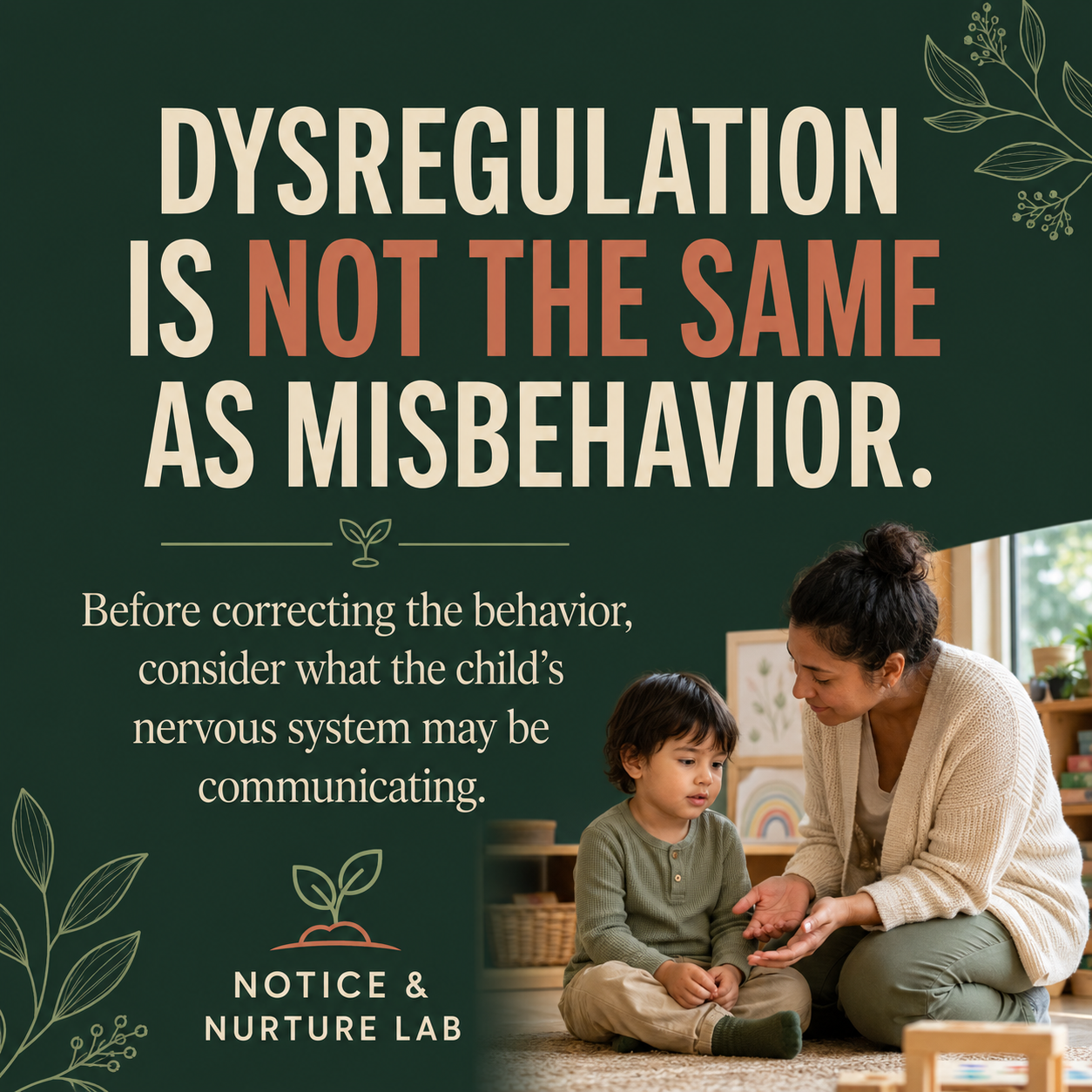
A preschool child refuses to clean up, hides under a table, pushes materials away, covers their ears, or begins to cry when the class changes activities.
From the outside, the behavior might look defiant, disruptive, or intentionally difficult. But behavior alone does not tell us why something is happening.
What appears to be misbehavior may sometimes be a sign that a child is overwhelmed and does not currently have access to the communication, regulation, or problem-solving skills the situation requires.
Before correcting the behavior, it can help to pause and ask a different question:
What might this child’s behavior be communicating?
What Is Dysregulation?
Dysregulation occurs when a child has difficulty managing their emotional, sensory, physiological, or attentional state well enough to meet the demands of the moment.
A dysregulated child might:
Cry, yell, push, hit, or throw objects
Run away, hide, or drop to the floor
Become unusually quiet or withdrawn
Cover their ears or close their eyes
Repeat words, sounds, or movements
Refuse an activity or transition
Have difficulty processing directions
Seek intense movement or sensory input
Appear unable to use familiar skills
These behaviors do not automatically prove that a child is dysregulated. They are signals that invite adults to observe more carefully.
Why the Difference Matters
When adults assume that a child is deliberately misbehaving, the response often focuses on stopping the behavior as quickly as possible.
The adult might repeat the direction, increase the demand, remove a preferred item, introduce a consequence, or insist that the child comply.
If the child is already overwhelmed, those responses may add more language, pressure, uncertainty, or sensory input to an overloaded system. The behavior may intensify—not because the child is trying to “win,” but because the original need remains unresolved.
A regulation-informed response does not mean ignoring unsafe behavior or removing every expectation. It means considering whether the child can successfully meet the expectation in their current state.
A child may need support returning to a more regulated state before they can listen, communicate, solve a problem, or try again.

What Might Be Contributing?
Behavior is influenced by context. When a child is having difficulty, consider what was happening before, during, and around the moment.
Sensory input
Was the environment loud, crowded, bright, visually busy, or physically uncomfortable? Was the child seeking movement, pressure, touch, or another form of sensory input?
Communication demands
Did the child understand what was expected? Did they have a reliable way to request help, ask for a break, reject something, or communicate discomfort?
Transitions and uncertainty
Did something end unexpectedly? Was the next activity unclear? Did the child have enough warning and processing time?
Task demands
Was the activity too difficult, too long, unfamiliar, or insufficiently supported? Was the child being asked to use skills that were not yet available independently?
Physical needs
Could hunger, fatigue, illness, pain, toileting needs, or general discomfort be affecting the child’s capacity?
Emotional and relational factors
Was the child separated from a trusted adult, navigating a conflict, recovering from an earlier stressful experience, or needing reassurance and connection?
No single question will explain every behavior. The goal is not to guess correctly in the moment. The goal is to slow down, gather information, and remain curious.

Regulation Before Reasoning
Young children depend on supportive adults to help them organize their experiences. A calm adult can reduce language, soften their tone, slow the interaction, adjust the environment, and provide predictable support.
Depending on the child, that might mean:
Using fewer words
Allowing additional processing time
Offering a visual cue
Reducing noise or other sensory input
Providing access to movement or a quieter space
Acknowledging the child’s communication
Offering two manageable choices
Staying nearby without demanding interaction
Helping the child understand what will happen next
Returning to the expectation when the child is more available
Support should be individualized. A strategy that helps one child may overwhelm another. Even a familiar strategy may not work the same way every day.
This is why noticing patterns is more useful than searching for one universal calming technique.
Understanding Does Not Mean Permitting Harm
Looking beyond behavior does not mean that adults should ignore hitting, biting, running into danger, or other unsafe actions.
Safety still matters.
Adults may need to block unsafe behavior, move dangerous objects, create space, or guide other children away. These actions can be taken calmly while using the least intrusive support possible.
Once everyone is safe, adults can consider what contributed to the moment and what environmental, relational, communication, or instructional changes might reduce the likelihood of it happening again.
The goal is not simply to stop a behavior. It is to understand what the child needs in order to participate more safely and successfully.
Replace Assumptions With Curiosity
It is not always possible to determine whether a behavior reflects dysregulation, avoidance, communication, a developing skill, or several factors at once.
Adults do not need to know the exact cause before responding compassionately.
We can begin by replacing assumptions with questions:
What changed?
What signals did I notice?
What was the child being asked to do?
What might have made this moment difficult?
What helped—or made it harder?
What could we adjust next time?
When adults pause long enough to notice the child and the context, behavior becomes information rather than simply a problem to eliminate.
Use the Free Dysregulation Reflection Tool
The free Notice & Nurture Dysregulation Reflection Tool provides families and educators with a simple framework for looking beyond behavior, considering possible contributing factors, and identifying supportive next steps.
Download the free Dysregulation Reflection Tool
Notice the signals. Understand the context. Nurture belonging.
This resource is intended for educational and reflective purposes. It does not provide medical advice, diagnosis, or individualized treatment.